
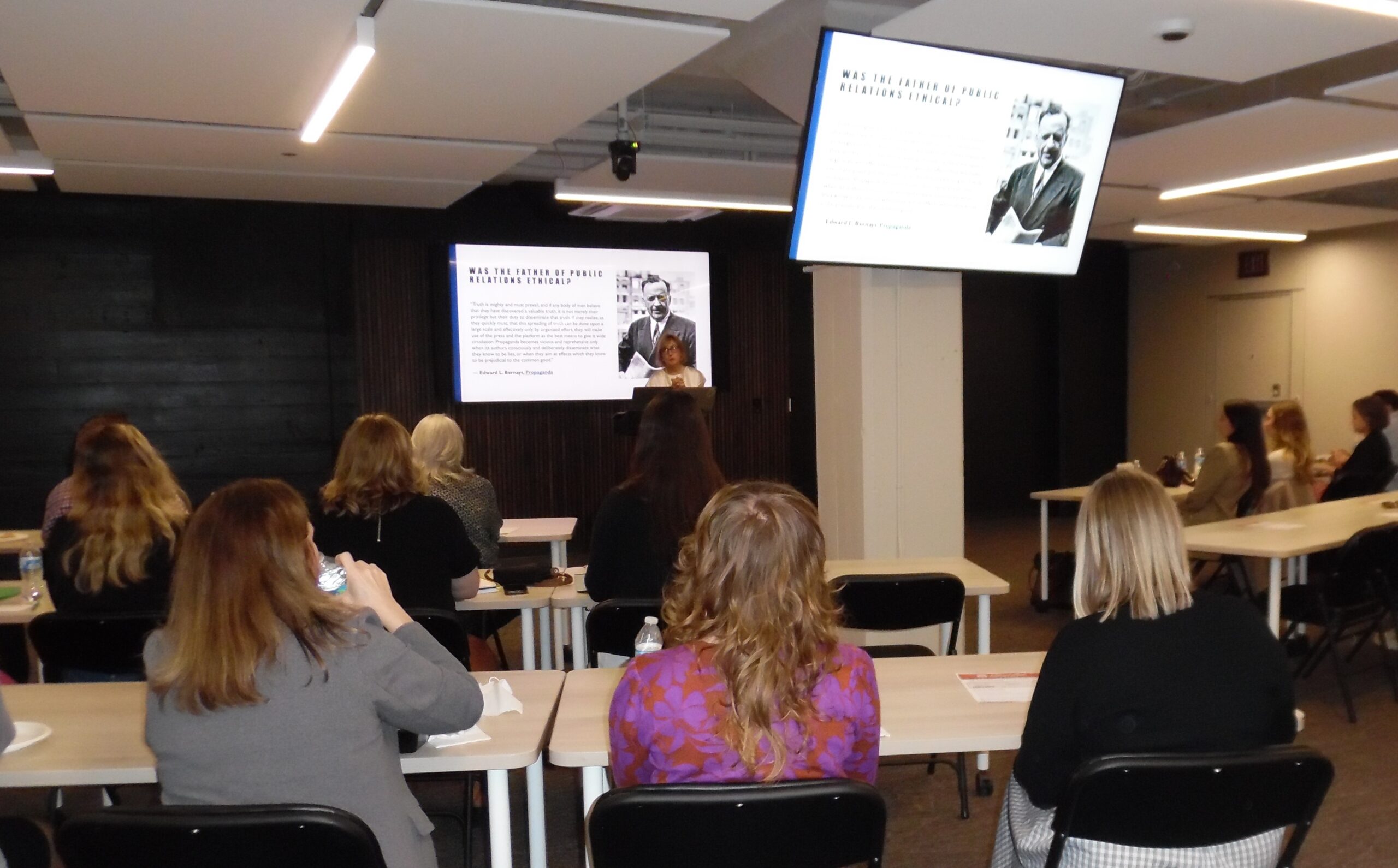
The Tulsa chapter of the Public Relations Society of America (PRSA) represents more than 100 members in the public relations, communication, journalism, marketing, and advertising professions, according to www.prsatulsa.com.
The organization conducts monthly workshops for members and guests where attendees can learn different aspects of the public relations profession. One of the events, The Art and Science of Influencer Marketing, occurred at Gradient, Tulsa’s Hub for Innovation, 12 N. Cheyenne Avenue, in Tulsa on May 26.
Annie Davenport, influencer marketing lead at Honeymoon, a public relations and advertising agency, gave a presentation on the influencer industry, its art and science.
“In 2026, the influencer industry reached a value of 35-40 billion dollars,” she said.
“Eighty percent of marketers use influencers,” Davenport added. “Return on investment (ROI) is $5.78 to every $1 in the influencer’s market.”
“Sixty-one percent of consumers trust influencers over brand content,” she revealed.
Davenport defined social media as a symbiosis of art and science.
“To become a good influencer, think culture and being social first, not brand first,” she said.
“Your authenticity is your biggest advantage. Be yourself, talk about yourself, what is happening in your life,” Davenport explained.
Making marketing feel human, storytelling, and cultural translation are very important on the road to an influencer’s success, according to Davenport.
The science of influencing on social media was defined as making influence measurable.
Nowadays, advertisers and marketers are looking at influencers’ engagement rates or interactions, such as likes, comments, shares, saves, and clicks.
Davenport said that a good engagement rate for an influencer is two percent or more. She emphasized that social media science includes data, distribution, and conversion.
For data rates, Captive, Melewar, and Sprout apps are usually used. For distribution and conversion rates, Meta, ShopMy, Linktree, and Substack (Internet platforms) are recommended.
Davenport also reported that the most popular social media in the United States are Facebook, Instagram, and TikTok.
When asked about using AI in influencers’ work, she suggested to ask AI to give samples of the best social media collaborations of the day. The information received could help influencers to be more competitive and connected with their audiences.
Also, Tulsa Community College offers an online social media marketing class. The class is usually eight weeks long. It provides a detailed review of how to utilize about 10 social media platforms and how to use Hootsuite software. Additionally, HubSpot email marketing is covered in the class, along with Google Analytics. TCC students enrolled in the social media marketing class can obtain Hootsuite, HubSpot, and Google Analytics certificates during the class and attach them to their resumes.
For more information about PRSA, contact membership@prsatulsa.com.
To enroll in the social media class, contact your TCC adviser or email academicadvising@tulsacc.edu.


