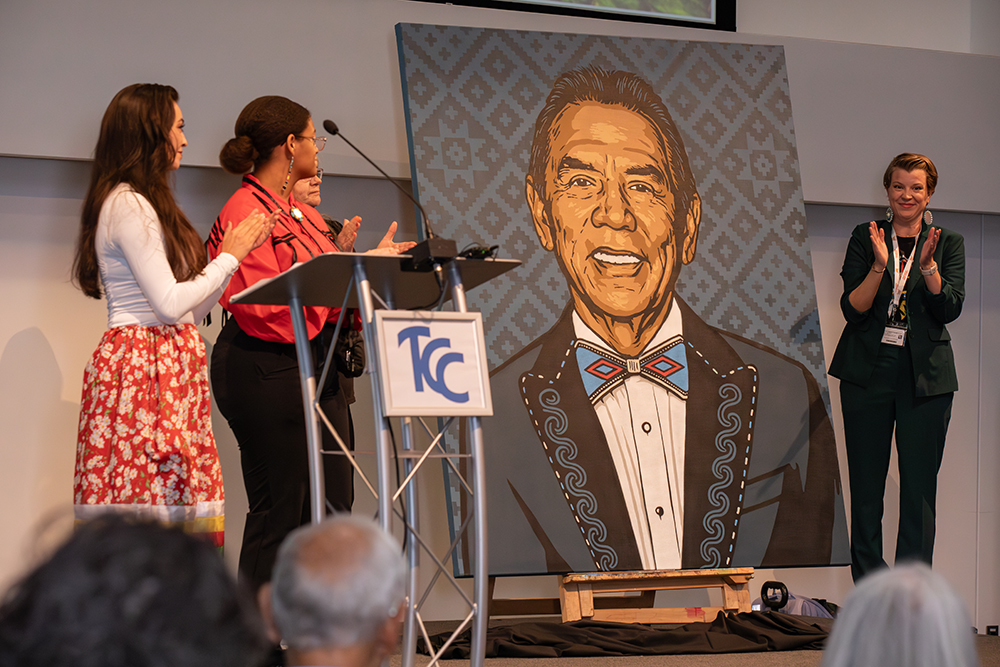
The audience clapped and cheered, and Wes Studi smiled as he watched from his seat. He watched as Tulsa Community College students and faculty unveiled a six-by-five-foot portrait of his face.
The artwork depicted his 2019 Academy Award win. It was the moment he became the first Native American actor to receive an Oscar Lifetime Achievement Award.
This unveiling was the climax of a multi-semester project. The project’s goal was to bring the TCC alumnus home and honor his contributions to the Native American community.
Tulsa Community College’s Native American Student Alliance (NASA) hosted the event on Nov. 10 at the Thomas K. McKeon Center for Creativity on TCC’s Metro Campus.
The event recognized Studi’s groundbreaking career, honoring his decades of work and legacy, which have elevated Native voices in Hollywood and beyond.
The atmosphere was set by a special cultural presentation from the Toscanini Club singers who performed Native American songs honoring age-old traditions.

The room was filled with community members, students, and tribal leaders. Mark Wilson, a TCC faculty member, opened the program and served as the master of ceremonies. He began by praising TCC as a valuable community partner and went on to recognize important attendees in the audience, including former Cherokee Nation Principal Chief Ross Swimmer.
Wilson noted the event followed Veterans Day. He spoke about the deep respect for military service in Native communities.
“We uplift veterans each and every day,” Wilson said. He honored Studi’s own service as a U.S. Army veteran in Vietnam and asked for a moment of silence for every veteran who has served and is currently serving his/her nation.
In honor of veterans, the Cherokee Nation Honor Color Guard was brought in as the Toscanini Club group performed a memorial song. There was a solemn presentation of the flags. After the presentation, the group performed a victory song as the honor guard exited.

TCC’s Dean of Liberal Arts and Public Services, Dr. Brad Duren, delivered a formal land acknowledgment. He recognized the college’s campuses sit on reservation lands, lands that belong to the Muskogee, Osage, and Cherokee nations. Duren pledged TCC would “profess truth that is often buried in uncomfortable histories of silence.”
Amanda Swope, director of Tribal Policy & Partnership for the City of Tulsa, spoke on behalf of Mayor Monroe Nichols. She welcomed Studi home to a “different” Tulsa. She noted that he entered the film industry before Oklahoma became “the pillar for film” it is now, and he helped “highlight Tulsa and Oklahoma.”
Cherokee Nation Principal Chief Chuck Hoskin Jr. spoke next. He thanked NASA students for organizing the event. He spoke about Native perseverance.
“We have had for the last five centuries, our fair share… of troubles,” Hoskin said. “Every time we got knocked down, we just stood back up. Every time our people bent, we didn’t break. And that’s why we’re still here.” He called this time the “greatest of Native American centuries.”

NASA President Ivy Collins and Vice President Kilani Frazier explained the event’s origin. They said NASA received a tribal grant in 2022, and the students decided to use the funds to honor Studi. This led to the commissioning of the portrait of Wes Studi. They applauded their advisor, Wes Mosher, for leading the effort.
TCC Professor Stephen Woods then gave Studi’s biography. He detailed Studi’s life. Studi was born in Nofire Hollow and grew up speaking the Cherokee language. Woods detailed his service in Vietnam. He also discussed Studi’s activism at Wounded Knee in 1973. Woods noted that Studi enrolled at Tulsa Junior College (TJC), now TCC, on the GI Bill. This is where he began acting with a Tulsa theater company.
After Woods’ speech, a video presentation was played, highlighting Studi’s career. It featured a reel of his most iconic film roles, including clips from Dances with Wolves and The Last of the Mohicans. Peers and critics praised his work in the video. They said he “shattered stereotypes” and “redefined the image of Native Americans for all time.”
The presentation noted that Studi brought dimension and humanity to his characters, connecting his performances to his life experiences as a Cherokee speaker, Vietnam veteran, and an activist for Native American rights.

Wes Studi took the stage to a standing ovation after the video presentation. He called TCC his “alma mater” and said he was “overwhelmed” by the honor. Recalling his time at TCC in the 1970s, he said he was part of a student group called the “Indian Club.” He guessed NASA was an “outgrowth” of that first club.
He connected his early activism at TCC to the rise of modern tribal sovereignty. He recalled participating in the Trail of Broken Treaties movement.
“I am proud to have been a part of that political movement that has gotten tribes to where we are today,” Studi said. “And that started here for me.”
He encouraged students to ensure they are always prepared to make the most of opportunities saying, “opportunity can come to you at any given time, but it really helps if you’re prepared.”
Studi also highlighted how friends and faculty at TCC encouraged his early interests.
He said, “You come from a long line of people who made things happen. TCC gave me a place to grow. Don’t let anyone tell you otherwise.”

After his address, the portrait of Studi was unveiled. Cherokee artist Brian Wade Tula and Nick White created the portrait. After the unveiling, Studi signed the portrait and took pictures with the organizers around it. The portrait will be permanently displayed at TCC’s Northeast campus.
The celebration concluded with a final honor song from the Toscanini Club singers. TCC history professor Mark Boland gave the closing prayer.
Boland spoke directly to Studi. “Thank you for being a champion of our language,” Boland said. “Thank you for being the face of a modern indigenous person.”

After the event, TCC Connection spoke with NASA president, Ivy Collins. She explained that NASA’s seeks to spread Native American culture to the entire student body, as she put it, the club is “for all people to join,” not only indigenous students.
She described Wes Studi’s impact as “very important” for challenging prejudice. His career, she said, counters the harmful prejudice of Native people being seen as “just a cartoon” and has helped “show the world… who we truly are instead of what people imagine us to be.”
The NASA president also credited the TCC faculty advisors for the event’s success. She noted that they had been “planning this for a year or two” and managed the complex logistics long before she became president.
Ultimately, Collins hopes the event served as a powerful message of inspiration. She wants other Native American children to see what Studi achieved and feel, “I can make it.” The goal is to show them that their dreams are “not just… a pipe dream,” but something they “can make a reality.”