In the previous article on Art Deco, I was diving into the depths of events dedicated to the 100th anniversary of the sophisticated art style. Those events have spread from Europe to North America, where Art Deco was a dominating trend in the 1920s-1960s.
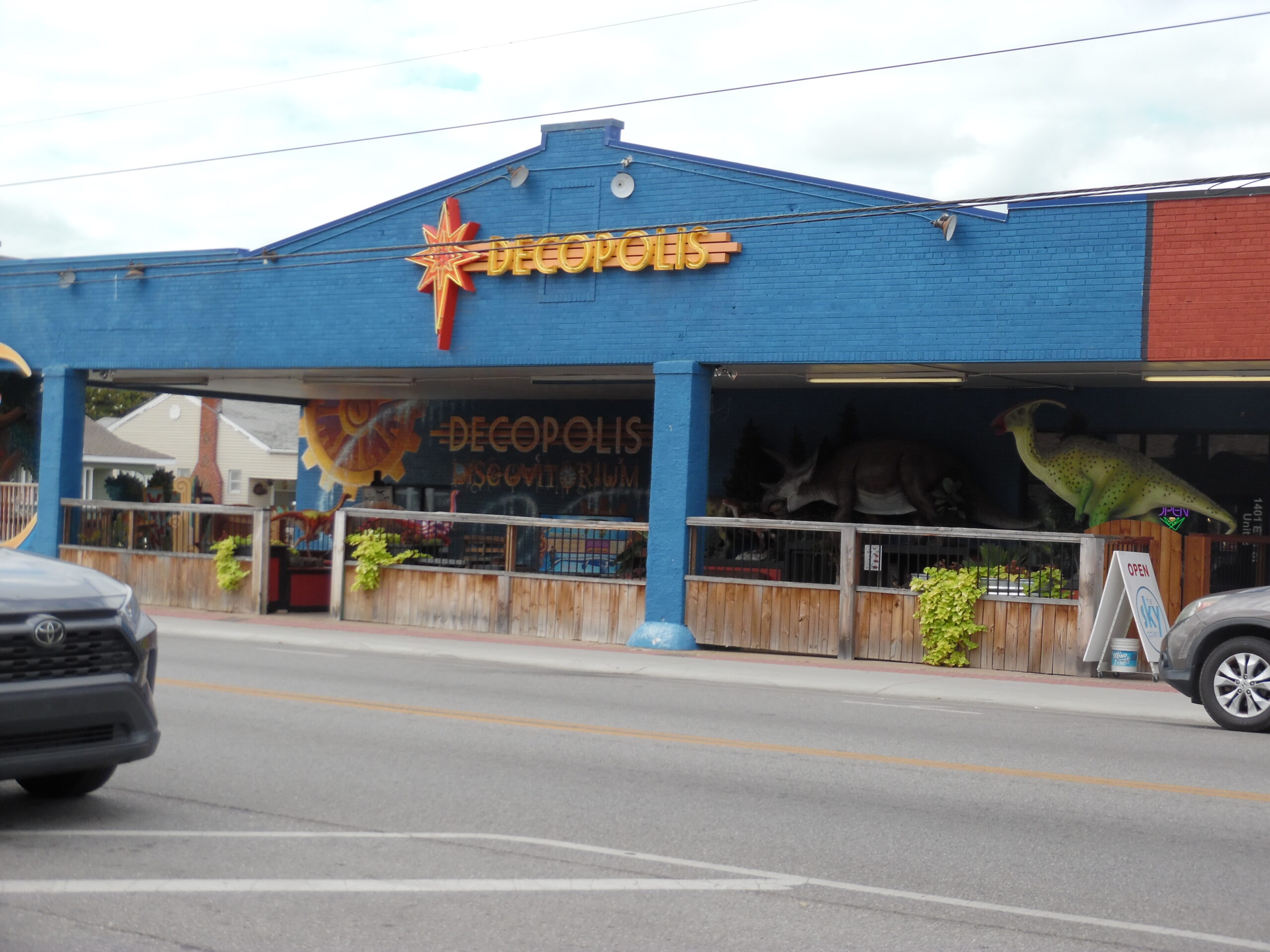
Tulsa has a lot to offer art admirers interested in Art Deco. One of the main attractions is the Tulsa Art Deco Museum located inside the Decopolis store at 1401 E.11th St., Unit B, Tulsa, right on historic Route 66.
The owner of Decopolis, William Franklin, is a third-generation artist. His parents and both grandmothers were artists. Franklin specialized in Trompe L’oeil murals and theatrical props and displays for the home, business, and entertainment industries, according to www.decopolis.net. His works are spread all over the United States and Europe, from Tulsa to New York City, Dallas to London.
The Tulsa Art Deco Museum has about a dozen items on display, such as sculptures, paintings, pottery, dishes, architectural fixtures, tin boxes, fans, and furniture.
The focal point above the main entrance to the Tulsa Art Deco Museum is a miniature copy of the “Goddess of Oil” sculpture, which is supposed to be placed in front of the Oil Expo Building (Expo Square currently), but the design was forgotten because of WWII.
Franklin’s grandmother, Marjorie Morrow Anderson, was a model for the “Goddess of Oil.” A poster in the museum tells a story about Anderson, who accepted the model’s job to earn money for college to become an artist. It happened in 1941. The “Goddess of Oil” is made in a realistic manner; it is youthful and gracious.
One of the Tulsa Art Deco Museum’s treasures is the “Spartiate,” or “Archer” sculpture, created by French artist Max Le Verrier in 1930.
“Le Verrier was known for being a pioneer in the Parisian Art Deco movement,” writes Franklin on his website. “In 1925, he showed his work at the famous Exposition Internationale des Arts Decoratifs et Industries Modernes in Paris, where he won a gold medal. His work can be found in museum collections around the world, including at the Musee d’Orsay in France…”
The composition of the “Archer” is a zigzag or geometric pattern, which is one of the main characteristics of Art Deco designs.
“Notice how the arms are perfectly parallel to the top of the base and ground, and how the cloth also mimics this. See how the one leg juts out almost exactly perpendicular to the line of the other leg and body, even the hair flowing back in lines along with the cloth, giving a look of horizontal movement and angularity,” Franklin describes the “Archer.”
“The angle of the forehead, nose, and front part of the body aligns. The tips of the elbow, cloth, and toes all align at almost the same angle on the other side. This pose was carefully and intentionally staged. The pose, along with the base, together evoke a kind of “look and feel” that was fresh, new, and modern for its time,” Franklin states.
The museum’s collection also includes the only sketch of the “Spartiate” in charcoal on parchment signed by Max Le Verrier.
Attending the Tulsa Art Deco Museum is a magnificent experience of traveling 100 years back in history. Franklin says that his actual collection of Art Deco items consists of approximately 1,000 pieces. He cherishes his dream to build additional premises for the museum next to the Decopolis TulsaRama, a new extension of Decopolis located at 5717 E. 11th St., Tulsa.
To be continued…