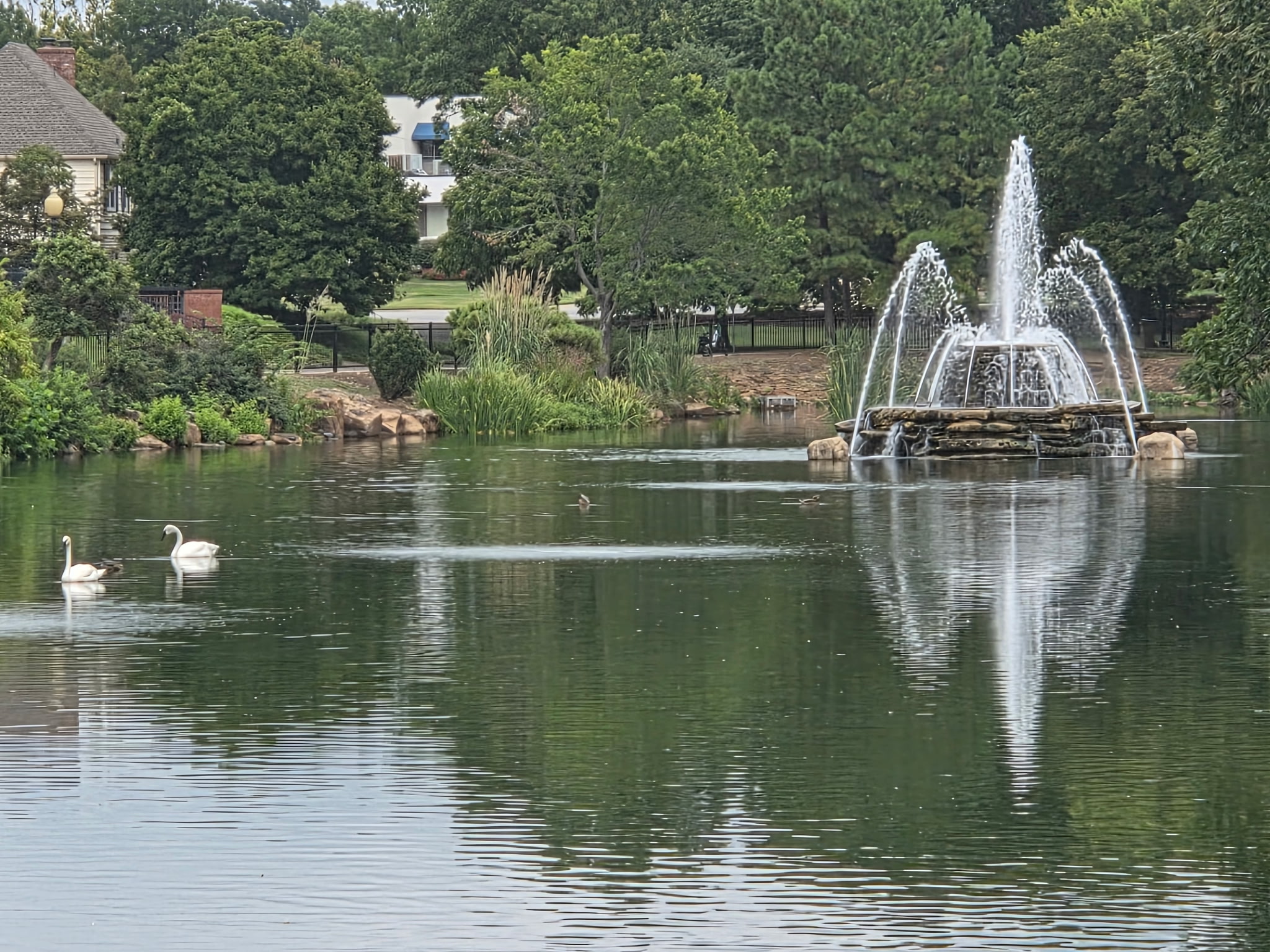
The fountain at Swan Lake Park, silent for nearly a quarter-century, is operational once more following a $2.2 million city-funded restoration completed in late 2024.
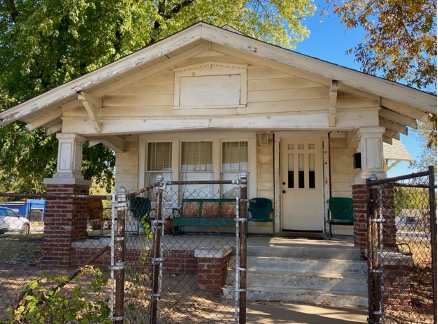
The historic Swan Lake district is located between 15th Street to the north, Utica Street to the east, 21st Street to the south, and Peoria Avenue to the west. The neighborhood is a residential area with notable architectural variety, featuring Spanish, Georgian Revival styles, and vernacular interpretations. Most structures were constructed in the 1920s and 1930s. Many of the houses in the area are similarly built, including two-story homes, quadruplexes, and six-plexes made of stone, clapboard, and stucco.
Like the history of many Tulsa neighborhoods, Swan Lake has a unique and, for many Tulsa natives, nostalgic addition to its past. What began as a cattle ranch in the early 20th century was owned by Col. Adolphus S. Orcutt. A spring-fed body of water known as Orcutt Lake served as a watering hole, and by 1908, Orcutt’s son built a park and an artificial lake. The amusement park and lake included a dance pavilion, a natatorium, an airdrome, and later a roller coaster.
By 1917, the amusement park had transitioned into a residential area. It was renamed Swan Lake by E.J. Brennan, to whom Samuel Augustus “Gus” Orcutt and his wife, Annie, sold the development. That same year, Brennan sold the public park to the city of Tulsa, and the park closed. Much of the land was later developed into residential houses and apartments.
Throughout the 1950s and 1960s, Swan Lake faced several development hurdles, particularly with surrounding infrastructure issues that persisted for decades. In 1987, a city bond issue funded major renovations of the lake and its central feature. However, a large rustic concrete foundation was abandoned in 2000.
In 2024, Tulsa voters secured $2.2 million needed to repair and rebuild the lake and improve water quality. The improvements include underwater aerators designed to prevent algae blooms and provide more oxygen for aquatic life. Additionally, a fence was installed to help protect the area.
TCC Connection interviewed neighborhood residents and advocates Tracy Hull and Jarrett Keck, who emphasized the importance of transformation and community stewardship. Hull, a resident who moved to the area about nine years ago, said the fountain had remained nonfunctional throughout her time there until the recent work.
“It’s never had a functioning fountain” until the 2024 project, Hull told TCC Connection.
She recalled hearing stories from longtime neighbors about earlier renovations 15 to 30 years ago.
Community members initially believed their fundraising, totaling about $100,000, might be enough for a basic restoration of the iconic fountain. However, Hull said residents were “heartbroken to find out that … it was way more serious than that.”
The extent of the infrastructure damage caused renovation costs to climb between $2 million to $3 million, far beyond what the neighborhood had anticipated.
Despite the daunting price tag, renovations continued. Funds raised by residents contributed to a new fence, while the bulk of the funding ultimately came from the city’s Improve Our Tulsa project in the amount of $2.2 million. The goal was to replicate the original appearance as closely as possible.

With the fountain and pedestrian path improved, Swan Lake has regained its appeal, featuring an operating fountain, swans, and abundant wildlife. The swans were named Gus and Annie in honor of Samuel Augustus “Gus” Orcutt and his wife.
For many residents and visitors, the lake holds a deeply nostalgic place, one that emphasizes walkability and the importance of community.
Looking ahead, community leaders emphasized the need to protect the swans’ habitat.
Keck stressed the importance of public education, urging visitors not to feed the swans or fish irresponsibly, as both actions can harm bird health and disrupt the pond’s ecosystem. He also highlighted the need to prevent littering, particularly plastics and shiny objects that could endanger the birds.
Keck summarized the project’s spirit by connecting the physical restoration to Tulsa’s identity.
“It’s one of those charms that gives Tulsa its character,” he said. “It ties us back to history, our roots. It’s the original gathering place, and we want to continue that tradition.”
Supporters of Swan Lake’s revival believe its significance is more than a story of concrete, water, and feathers. It is a celebration of community resilience, living history, and the ongoing partnership between Tulsa’s residents and one of the city’s oldest landmarks.